News
What Is Pilotage in Shipping?

What Is Pilotage in Shipping?
Pilotage in shipping is an essential maritime service that supports the safe navigation of vessels when entering or leaving ports, transiting narrow waterways, navigating straits, or operating in areas where local conditions require specialist knowledge. During pilotage, a maritime pilot with detailed knowledge of local waters boards the vessel and provides professional navigational and manoeuvring support to the ship’s master and bridge team.
For large commercial vessels in particular, approaching a port, berthing, or departing from a terminal involves much more than the vessel’s technical capabilities. Water depth, currents, wind conditions, visibility, traffic density, port infrastructure, navigational restrictions, and local regulations can all directly influence an operation.
For international vessels calling at unfamiliar ports, pilotage in shipping provides an important connection between the vessel’s bridge team and local navigational expertise. It combines the experience of the ship’s master and officers with the pilot’s detailed knowledge of local conditions, helping the vessel navigate challenging waters in a safe and controlled manner.
Who Is a Maritime Pilot?
A maritime pilot is a qualified marine professional with specialist knowledge of a particular port, strait, channel, or waterway.
Maritime pilots are familiar with local water depths, currents, traffic patterns, navigational restrictions, berthing areas, port procedures, and other conditions that may affect vessel movements. This local expertise is particularly valuable when a vessel is calling at an unfamiliar port or navigating a challenging waterway.
The pilot normally boards the vessel at a designated pilot boarding area. Once on board, information is exchanged with the master and bridge team regarding the vessel, the intended passage, environmental conditions, and the planned manoeuvre.
The presence of a pilot does not replace the overall responsibility of the ship’s master. Instead, the pilot contributes specialist local knowledge and experience to support the master and bridge team throughout the operation.
Why Is Pilotage in Shipping Important?
Pilotage in shipping plays an important role in supporting navigational safety, particularly in areas with dense vessel traffic, narrow channels, limited manoeuvring space, or challenging local conditions.
A vessel engaged in international trade may call at many ports around the world, but every port presents a different operational environment. Local currents, shallow waters, traffic separation schemes, tug requirements, berthing arrangements, and port regulations may vary considerably from one location to another.
A maritime pilot provides the local knowledge necessary to help the vessel navigate these conditions safely and efficiently.
Effective pilotage therefore contributes not only to the safety of the vessel itself but also to the protection of its crew, other vessels, port infrastructure, and the marine environment.
How Does the Pilotage Process Work?
A pilotage operation generally begins before the vessel reaches the relevant port or pilotage area.
The vessel’s ETA – Estimated Time of Arrival is monitored, and the required pilotage arrangements are coordinated according to the vessel’s operational schedule. Any changes to the vessel’s ETA need to be communicated efficiently so that the pilot and other related port services can be arranged accordingly.
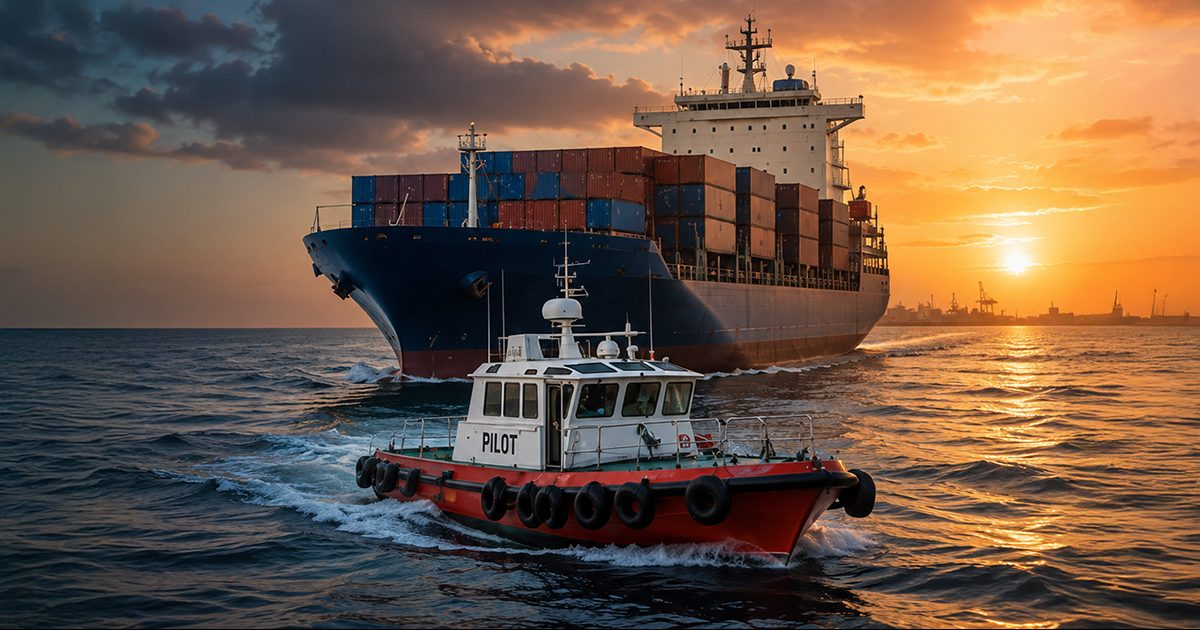
The maritime pilot is usually transferred to the vessel by a dedicated pilot boat at a designated boarding position.
Once aboard, the pilot exchanges relevant operational information with the master and bridge team. Factors such as the vessel’s draft, dimensions, manoeuvring characteristics, speed, weather conditions, currents, traffic situation, and potential tug requirements are considered.
For berthing operations, the characteristics of the berth and the intended manoeuvring plan may also form part of this assessment.
Following this exchange of information, the pilot uses local knowledge and experience to support the master during the vessel’s navigation and manoeuvring.
What Is the Role of a Pilot Boat?
The pilot boat is another important element of pilotage operations. Its primary function is to transfer the maritime pilot safely between the shore or pilot station and the vessel at designated pilot boarding and disembarkation points.
During transfers at sea, several factors need to be considered, including the vessel’s speed, sea state, wind, visibility, and other environmental conditions.
Effective coordination between the vessel and pilot boat is therefore necessary to ensure that the pilot can safely board or leave the vessel.
Although pilot transfer represents only one stage of the overall operation, it remains an important part of pilotage in shipping, particularly when transfers take place offshore or under challenging environmental conditions.
The Role of Pilotage in Port Operations
Pilotage does not operate in isolation. A successful port call requires effective coordination between several parties, including the ship’s master, maritime pilot, ship agent, port authority, terminal, tug operators, and mooring teams.
For larger vessels in particular, different stages of the operation must be carefully coordinated. The pilot boarding time, availability of tugs, berth readiness, and mooring arrangements may all be interconnected.
A delay in one part of this operational chain can affect the vessel’s port schedule and subsequent operations.
For this reason, arranging pilotage at the correct time contributes not only to navigational safety but also to the efficient management of the overall port call.
The Relationship Between Pilotage and Ship Agency
A vessel calling at a port may require numerous local services to be coordinated within a relatively short operational window. Pilotage is one of the key elements within this process.
A ship agent supports communication between the vessel and local stakeholders by monitoring ETA updates, coordinating with relevant authorities and service providers, and helping ensure that port arrangements reflect the vessel’s latest schedule.
Pilotage, tug assistance, berthing arrangements, and other port services may need to be coordinated according to continuously updated operational information.
Effective ship agency therefore involves more than arranging individual services. It also requires accurate and timely communication between all parties involved in the port call.
Effective pilotage in shipping consequently depends not only on professional maritime expertise but also on accurate information, timing, and operational coordination.
Are Pilotage, Towage and Mooring the Same Service?
Although pilotage, towage, and mooring may all form part of the same port operation, they perform different functions.
Pilotage provides the master with specialist local navigational and manoeuvring expertise.
Towage provides physical assistance to the vessel’s movement and manoeuvring when tug support is required.
Mooring services involve handling the vessel’s mooring lines during berthing and unberthing operations.
For large vessels, these services may need to work together within a carefully coordinated operational plan. Safe and efficient port operations therefore depend on different areas of expertise being available at the right place and at the right time.
International Standards and Navigational Safety
Pilotage is closely connected with the broader framework of navigational safety in international shipping. Local requirements may differ depending on the port, waterway, vessel type, and applicable regulations.
International guidance and standards relating to maritime and navigational safety are developed through organizations such as the International Maritime Organization (IMO).
Understanding both international principles and local requirements is an important part of planning safe and efficient vessel operations. At the same time, local authorities and pilotage organizations may establish specific procedures according to the navigational characteristics of their respective waters.
For this reason, vessels and their representatives should consider both international standards and applicable local requirements when planning a port call.
VAV Insight: Why Does Coordination Matter?
Pilotage in shipping is much more than simply placing a maritime pilot on board a vessel. Behind every successful pilotage operation are accurate timing, up-to-date information, and effective coordination between multiple operational parties.
A change in the vessel’s ETA can affect the pilot boarding time. A change in pilotage timing may subsequently influence tug availability, berth planning, mooring teams, and other port services.
For this reason, maintaining a clear overview of the entire operation and ensuring continuous communication between all relevant parties is essential.
At VAV Shipping House, we believe effective coordination between vessels, local authorities, and service providers is one of the fundamental elements of a successful port call.
In shipping, every detail matters. Accurate information, correct timing, and strong coordination help turn those details into safe and efficient operations.